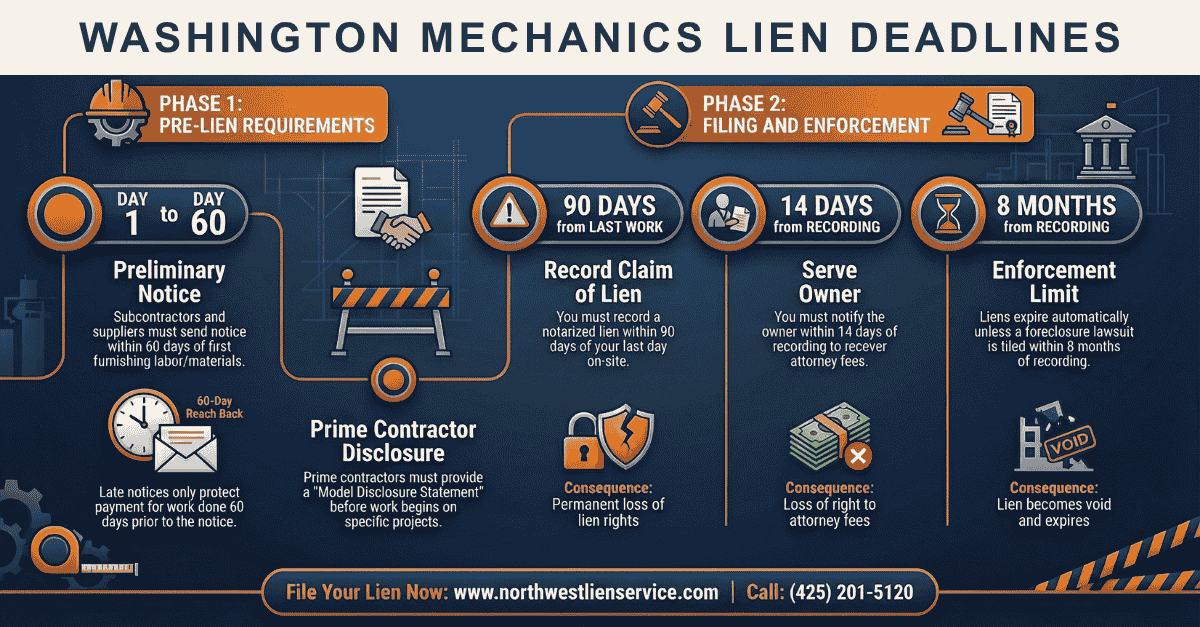
In Washington State, you have exactly 90 days from the last date you provided labor or materials to file a mechanics lien. If you remain unpaid, you must enforce the lien by filing a lawsuit within 8 months of recording, or the lien will expire.
Note: Missing either the 90-day filing window or the 8-month enforcement deadline results in the complete loss of your right to collect. If you are approaching your deadline, contact us or file a rush lien with us today to ensure your paperwork is recorded on time. Verified for accuracy by local lien specialists. Updated April 2026.
Navigating construction payment laws can be stressful. Here is everything you need to know about Washington mechanics lien deadlines so you don’t lose your right to get paid.
In Washington State, sending a Preliminary Notice (often called a Notice of Intent) is usually a mandatory first step to protect your right to get paid. However, the exact document you must send—and your deadline to send it—depends entirely on whether you are a prime contractor, subcontractor, or material supplier.
Washington state law (RCW 60.04) usually doesn’t require laborers providing only labor to send a pre-lien notice to protect their lien rights.
| Contractor Role | Notice Deadline & Requirements |
|---|---|
| Prime Contractors | Deadline: Before work begins Requirements:
|
| Subcontractors | Deadline: Within 60 days Requirements:
|
| Material Suppliers | Deadline: Within 60 days Requirements:
|
Missing a deadline in Washington means permanently losing your right to get paid. Whether you are a prime contractor, a subcontractor, or a laborer, the State of Washington applies the exact same strict timeline for filing and enforcing a mechanics lien (Chapter 60.04 RCW).
Universal Deadlines for All Roles:
Download our infographics guide below to quickly learn the WA mechanics liens deadlines.
We’ve helped thousands of contractors and suppliers file mechanics liens in California, Oregon, and Washington since 1999. We specialize in simplifying the process, meeting deadlines, and protecting your right to get paid without the legal guesswork.
Filing a lien yourself saves upfront service fees but exposes you to critical risks, such as invalidation and lawsuits, that a professional service eliminates.
| Feature | Do It Yourself (DIY) | Northwest Lien Service |
|---|---|---|
| Property Owner Verification | ❌ High Risk. You rely on the contract or tax bill, which may not list the legal owner of record. | ✅ FREE Title Search Included. We verify the actual property owner through official county records. |
| Legal Description (APN) | Manual Search. Using just a street address can invalidate your lien. Finding the APN is difficult. | ✅ Verified. We locate the exact legal description required by Washington law. |
| Forms & Compliance | Could be outdated. Generic forms found online may miss recent Washington legislative changes. | ✅ Guaranteed. Our forms are reviewed by experts to ensure 100% compliance with current statutes. |
| Filing Process | Time-consuming. Researching, driving to the recorder’s office, standing in line, or mailing and hoping it arrives. | ✅ Fast & Electronic. We use E-Recording in most counties for same-day filing. |
| Liability Risk | ⚠️ High. A clerical error can result in a “Slander of Title” lawsuit against you. | ✅ Protected. We file with accuracy so you avoid frivolous counterclaims. |
If you’re a contractor dealing with a difficult payment situation, I can’t recommend Northwest Lien enough. They know exactly what they’re doing and make a stressful situation a lot easier to navigate. I’ll definitely be using them again if I ever need to. – Brandon Emerson, Loyal Customer
Yes, calendar days are used to calculate the deadline. However, if your 90th day lands on a weekend or a legal holiday when the county auditor’s office is closed, the deadline usually rolls over to the next consecutive business day.
If you miss the 90-day window, your lien rights are completely void. You cannot file a late mechanics lien in Washington under any circumstances, and the county recorder cannot grant extensions.
No. A Washington mechanics lien expires exactly 8 months after the date it is recorded, and the state does not allow extensions or renewals. To keep the claim alive, you must file a lawsuit to enforce the lien before the 8-month period is up.
Yes. In Washington, an unpaid contractor, subcontractor, or material supplier can record a mechanics lien against your residential property, provided they follow all legal notice requirements and strict filing deadlines.
Yes. In Washington State, a contractor or supplier can record a mechanics lien with the county auditor without your direct knowledge, sometimes called a “silent lien.” However, Washington law (RCW 60.04.091) requires the claimant to serve a copy of the recorded lien to the property owner within 14 days of filing.
Yes, electronic signatures on lien waivers are generally accepted in Washington State as long as both parties agree to conduct the transaction electronically and the document clearly identifies the project and the amount being waived.
Yes. You are not legally required to hire an attorney to prepare or record a mechanics lien. However, because minor clerical errors or missed deadlines can completely invalidate the lien, many construction professionals choose to use a specialized lien filing service like Northwest Lien for accuracy.
In severe cases, yes. A lien does not immediately seize your property, but if the unpaid contractor successfully enforces the lien by filing a foreclosure lawsuit, the court can force the sale of the house to pay off the construction debt.
No. Washington State law does not require lien waivers to be notarized to be legally valid. However, some lenders or general contractors may write notarization requirements into their specific contracts.
Filing involves drafting a legally compliant Claim of Lien and recording it with the county auditor where the project is located within 90 days of your last day of work. For a complete, detailed walkthrough, read our full guide on How to File a Mechanics Lien in Washington.
The most reliable way is to perform a title search or check the public records at your local county auditor or recorder’s office. Under Washington law, the claimant is also required to mail you a copy of the lien within 14 days of recording it.
In Washington State, a mechanics lien is valid for exactly 8 months from the date it is recorded. If a lawsuit is not filed to enforce the lien before the 8 months expire, the lien becomes void and is no longer enforceable.
If you believe the lien is frivolous or legally invalid (such as a missed deadline or an unlicensed contractor), you can file a motion in county court to have a judge remove it. Otherwise, valid mechanics liens cannot simply be ignored; they must be settled, bonded around, or defeated in court.
Washington law does not specify a statutory minimum dollar amount required to file a mechanics lien. However, because of the costs associated with recording fees and potential legal enforcement, filing a lien for very small debts may not be financially practical.
Mechanics liens are strictly enforced, and even a small clerical error can invalidate your claim. The most common mistakes include:
The most common lien on personal property is a consensual lien, such as an auto loan or equipment financing, where the borrower voluntarily agrees to let the lender use the property as collateral until the debt is paid.
Disclaimer: This article is for informational purposes only and does not constitute legal advice. Mechanics lien laws are complex and vary by jurisdiction. For specific legal guidance regarding your situation, please consult with a qualified attorney licensed in Washington.