The primary penalty is the forfeiture of all lien rights. Under California Civil Code § 8422, if a claimant willfully includes labor or materials not furnished to the property, the entire lien is declared void. This leaves the contractor with no security for their payment.
Note: Courts distinguish between honest mistakes and fraud. In most cases, a simple math error or clerical mistake will result in the court reducing the lien to the correct amount rather than dismissing it entirely. But willfully inflating a claim to use as leverage against an owner triggers these severe penalties. Read our full guide below, reviewed for accuracy by lien specialists. Updated: March 2026. Reach out to us for any questions to avoid penalties. Call 310.750.0697.
Avoid penalties. Let the professionals handle it for you.
Watch this short, straightforward guide on the penalty for filing a false mechanics lien in California and how to dispute a frivolous lien. Explained in under one minute.
Filing a false mechanics lien in California results in the immediate invalidation of the entire lien, making the debt unsecured. Under California Civil Code § 8422, courts apply a strict “all-or-nothing” rule: if a claimant willfully includes costs for labor or materials they did not provide, they forfeit the right to the lien entirely rather than just having the amount reduced.
Save this infographic for your reference:
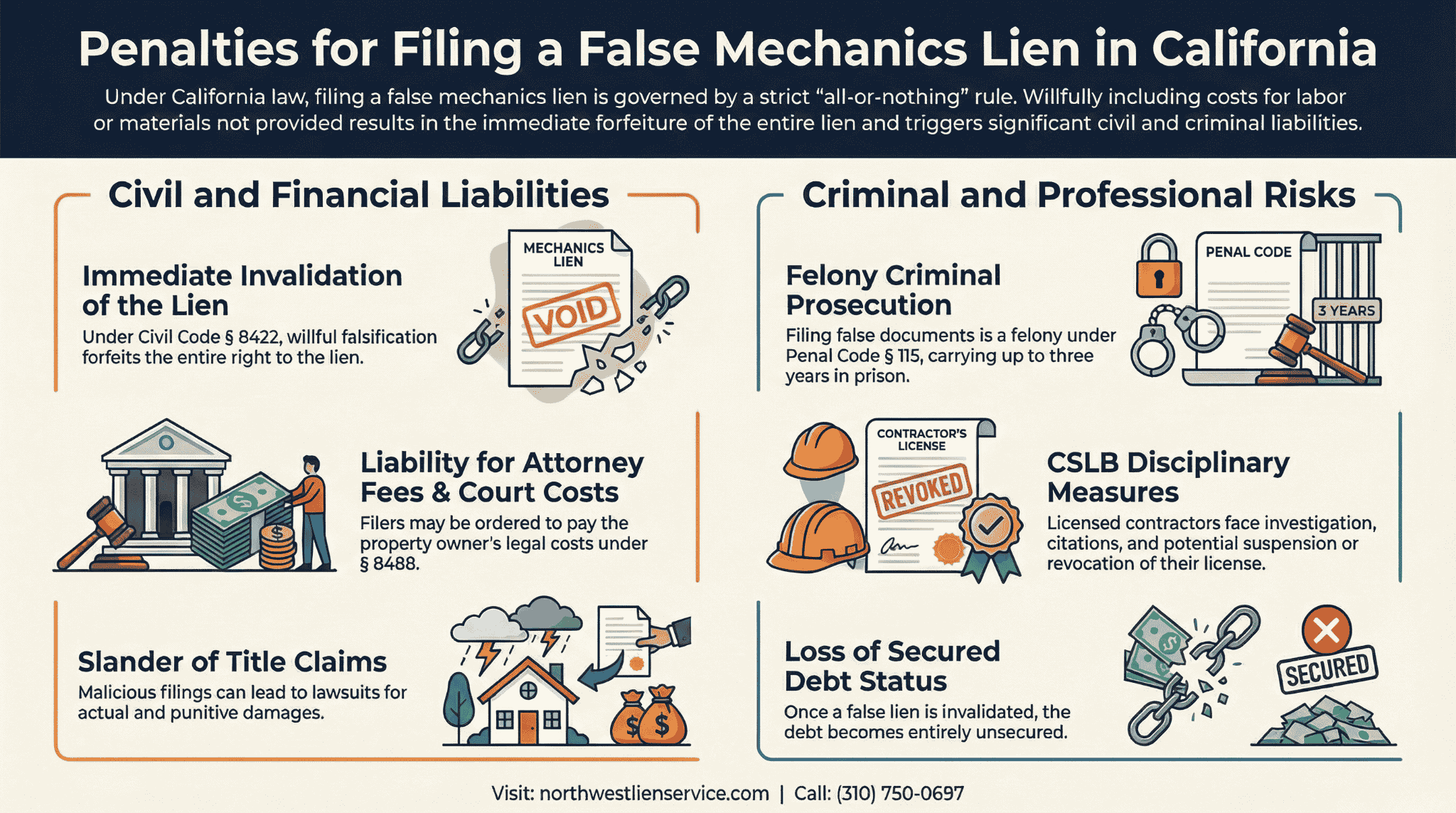
Beyond simply losing the right to be paid, filing a fraudulent or malicious lien in California exposes the contractor to significant legal and financial liabilities.
If a property owner successfully petitions the court to release a false or invalid lien, they are typically entitled to recover their legal costs from the filer under Civil Code § 8488.
Filing a false lien can lead to a civil lawsuit for “slander of title.” This occurs when a contractor records a lien with malice (i.e., with intent to annoy or harm) and without a valid legal basis.
In extreme cases involving intentional fraud, such as filing liens for work never performed or using forged documents, the act is treated as a crime.
Licensed contractors who file fraudulent liens risk their livelihood. The Contractors State License Board (CSLB) can investigate these claims and impose disciplinary measures, including:
A mechanics lien in California is considered invalid when the claimant doesn’t meet the legal prerequisites. Most commonly notice failures, missed deadlines, or a claim that includes non-lienable or willfully inflated amounts. Key facts:
Do this next:
To fight a mechanic’s lien in California, challenge whether it was filed correctly (notice + timing + amount) and push for release; if it isn’t released, you can use a court process to remove it.
Owners can petition the court to release an improper lien (California’s lien release petition procedure). If the owner wins, attorney fees/costs may be recoverable under the lien release statutes (commonly cited under Civil Code § 8488 in this context).
To dispute a lien on your property in California, you either (a) prove it’s procedurally invalid (late, notice defects, wrong claimant, wrong amount) or (b) contest the underlying debt, then force a release or pursue court removal.
Many disputes turn on whether required notices were properly served (especially the 20‑day preliminary notice for parties who must give it). A lien can cloud title even if it’s ultimately invalid, so disputing it is often about clearing title fast.
Do this next:
Since 1999, Northwest Lien Service has helped thousands of contractors get paid quickly with simple, reliable, and effective lien services. We are proud to recover an average of $2 million annually for our clients.
“NW Lien has assisted our company with several claims, and they have all ended with us getting paid. Their customer service is great, informative, and they have made the process very easy. [They] always deliver top-notch customer service, they are amazing to work with, and I highly recommend working with them.”
Cassie Endicott
Get our 5-step lien filing process + California 20-day notice and lien deadlines cheat sheet.
A contractor typically has 90 days from the date the project is substantially completed to record a mechanics lien. However, if the property owner records a Notice of Completion, this window shrinks to 60 days for direct contractors and just 30 days for subcontractors and suppliers. Missing this deadline invalidates the lien.
Technically, yes, a lien can be recorded without your immediate permission, but you must be notified. California lien law requires the claimant to serve you with a copy of the lien via certified or registered mail at the time of recording. If you never received this notice, the lien may be unenforceable, but it could still appear on your property title until removed.
Generally, no. Failing to finish a construction job is a breach of contract (a civil matter), not a crime. However, if a contractor takes a deposit and abandons the job without doing any work—or diverts funds meant for materials to other uses—they could face criminal charges for theft or diversion of construction funds, which can lead to jail time.
To prove a lien is invalid, gather evidence of procedural errors.
The fastest way is to get the claimant to sign a Mechanics Lien Release form. If you’ve paid the debt, they are legally required to release the lien immediately. If they refuse, you can file a court petition to remove it. Need to clear a title quickly? Contact us to file a professional Lien Release today.
Foreclosing on a lien means filing a lawsuit to force the sale of the property to pay the debt. In California, you must file this lawsuit within 90 days of recording the lien. If you miss this strict deadline, the lien expires and can no longer be enforced. This is a complex legal process that typically requires an attorney.
Yes, if they provided labor or materials for your home improvement project and were not paid, they have a constitutional right to file a mechanics lien. This applies even if you paid your general contractor, but they failed to pay their subcontractors (a scenario known as “double payment risk”). Ensuring you receive Lien Waivers with every payment is the best protection against this.
Practically speaking, yes. They are both invalid liens that cloud your title. A fraudulent lien typically involves criminal intent (like forged documents or made-up debts), while a frivolous lien may just be legally groundless (like a lien filed by an unlicensed contractor). However, both can be removed through the same court petition process and can subject the filer to penalties and attorney fees.
Yes. Most parties without a direct contract with the property owner must send a preliminary notice (prelim) to preserve mechanics lien rights. This typically includes subcontractors, suppliers, and equipment rental companies. Direct contractors generally don’t send one to the owner, but may need to notify the construction lender on financed projects.
You can still send the notice, but your lien rights will be limited. If sent late, the notice covers only work performed in the 20 days prior to the mailing date and all work thereafter. You effectively forfeit the right to lien for any work done before that 20-day lookback window.
No. California law generally prohibits waiving lien rights or notice requirements in advance. Any contract clause that attempts to waive the preliminary notice requirement is void and unenforceable. Notices must be sent to ensure a valid lien claim later.
No. A preliminary notice is only a notice; it does not encumber the property or appear on a title search as a debt. It simply alerts the owner and lender that you are working on the project and have the right to file a lien later if unpaid.
Yes, it can be. While most lien disputes are handled in civil court, filing a fraudulent document with a public office (like the County Recorder) is a crime. Under California Penal Code § 115, knowingly procuring or offering any false or forged instrument to be filed, registered, or recorded in any public office within the state is a felony.
While prosecutors typically reserve this for clear-cut cases of fraud (like “paper terrorism” or forged deeds), it remains the ultimate penalty for filing a false mechanics lien in California when malicious intent is proven.
Generally, no. For subcontractors and material suppliers, serving a 20-Day Preliminary Notice is a mandatory legal prerequisite. If you failed to send this notice within the timeframe, you have likely forfeited your right to file a valid mechanics lien. The only common exception is for direct contractors (those who signed a contract directly with the property owner), though they must still notify construction lenders.
Legally, abandoning a project is a breach of contract, which exposes the contractor to civil lawsuits for damages (the cost for the owner to hire someone else to finish). A contractor cannot file a lien for the full contract value if the work is incomplete; they may only lien for the value of labor/materials actually installed. Filing a lien for unearned amounts can trigger the penalties for a false or fraudulent lien under Civil Code § 8422.
While generic PDFs exist online, using an outdated or incorrect form can fail to clear the property title, leaving you liable for legal fees. The “Release of Mechanics Lien” must be notarized and recorded with the exact same county recorder’s office as the original lien. Don’t risk a defect. Reach out to our lien specialists to ensure your release is prepared and recorded correctly.
Downloading a free template is risky because California law requires specific statutory language (including the “Notice of Mechanics Lien” text) and precise legal descriptions. A single typo can render your lien invalid. Instead of guessing, file your lien in 48 hours or less with our Rush Lien service. We handle the drafting, verification, and recording to ensure your claim is enforceable.
A fraudulent lien is recorded with willful intent to defraud the property owner, often by claiming payment for work never performed, inflating amounts significantly beyond what is owed, or using forged documents. In California, this can lead to felony charges under Penal Code § 115 and total forfeiture of lien rights.
A frivolous mechanics lien in California is filed without any reasonable legal or factual basis. This differs slightly from fraud in that it might lack “malicious” intent but is still legally groundless—for example, a lien filed by an unlicensed contractor or for a project type not covered by lien laws. These are subject to rapid removal via a court petition.
A payment dispute (or contractor dispute) is a disagreement between a contractor and a property owner (or general contractor) regarding money owed. This is the underlying trigger for most mechanics’ liens. While legitimate disputes over quality or scope are common, using a lien to forcefully leverage a settlement in a dispute where no valid debt exists can be penalized.
The California Civil Code (Sections 8400-8494) grants contractors, suppliers, and laborers a legal right to secure payment for their work. These laws establish strict deadlines and notice requirements for recording a lien against a property.
Key Components:
Disclaimer: This article is for informational purposes only and does not constitute legal advice. Mechanics lien laws are complex and vary by jurisdiction. For specific legal guidance regarding your situation, please consult with a qualified attorney licensed in California.