Filing a mechanics lien in California requires strict adherence to three main deadlines. Missing any step can invalidate your claim and forfeit your right to payment.
Note: Deadlines are strict. If a Notice of Completion is filed, your recording window shrinks to just 30 days (for subcontractors) or 60 days (for direct contractors). Read our full step-by-step guide below. Reviewed for accuracy by lien specialists. Updated March 2026.
Watch the five steps in filing a construction lien in California, explained in less than 2 minutes in this simple video.
A mechanics lien—often called a construction lien, contractor’s lien, or materialman’s lien—is a legal claim filed against a property by someone who provided labor or materials but wasn’t paid. In California, this right is so fundamental that it is embedded in the state constitution (Cal. Const., art. XIV, § 3). Technically, recorded as a “Claim of Lien,” this document places a “hold” on the property title. This makes it difficult for the owner to sell or refinance until the debt is paid, giving you powerful leverage to recover your money.
A California construction lien can be filed by anyone who provides labor, services, equipment, or materials that permanently improve real property, provided the work was not fully paid for. Here’s a breakdown of who is eligible under California Civil Code §§ 8400–8410:
To qualify, you must be licensed (if required for your trade) and have made a permanent contribution to the work of improvement.
Home improvement lenders cannot file a mechanics lien in California. Although they provide funds to facilitate a project, they do not provide the “work of improvement” itself.
In California, you must give a 20-day preliminary notice and then record a signed Claim of Lien with the county recorder within 90 days of the last work. It needs the owed amount, owner info, project details, and the legal notice. Here are the key requirements for a valid Mechanics Lien in California:
Disclaimer: This is a general informational checklist, not legal advice. Deadlines are strict, and errors can be fatal to your claim. Always consult a qualified lien specialist.
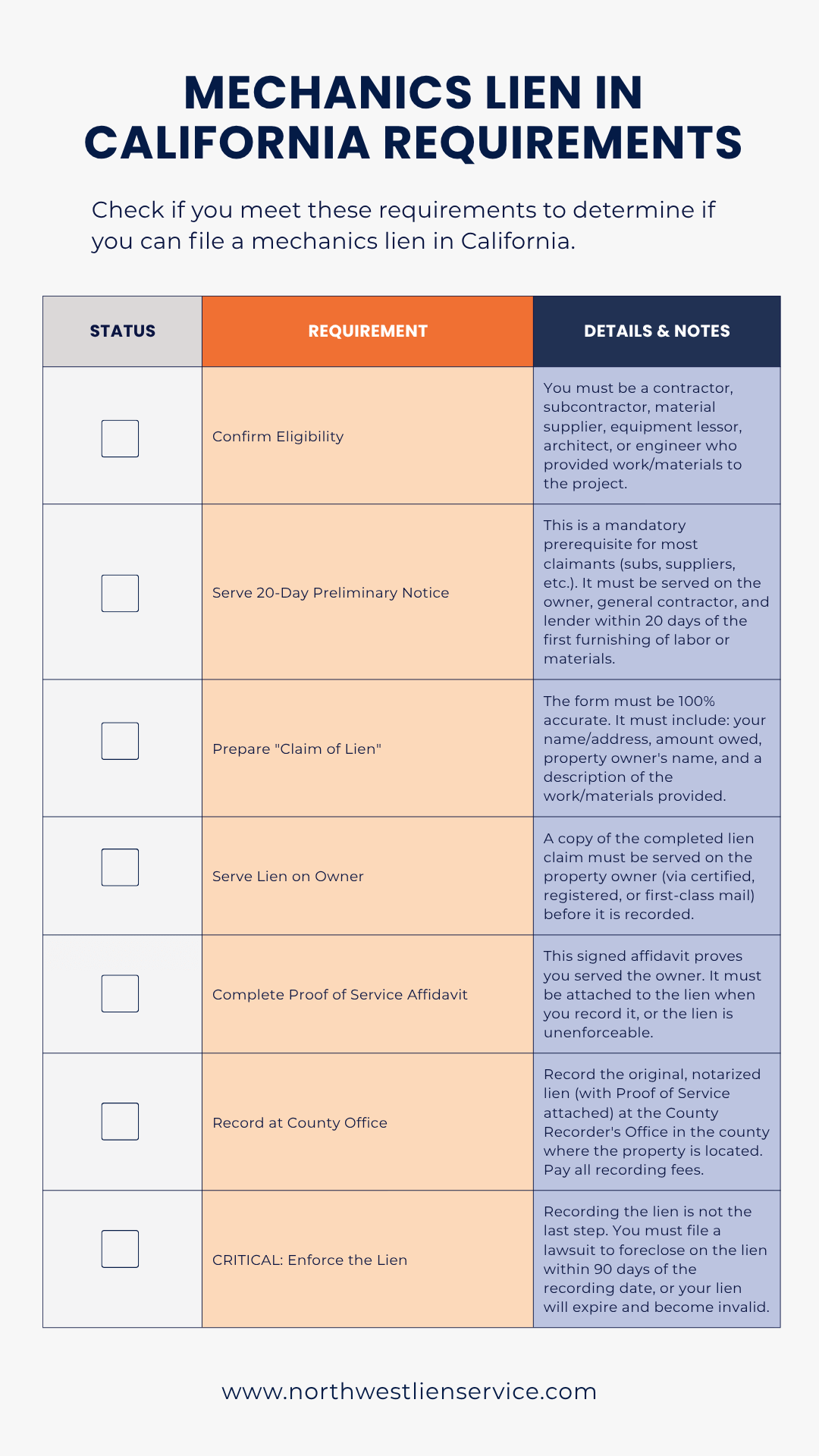
Download and print our California mechanics lien checklist.
Strict deadlines govern this California lien law process. Failing to meet any date may result in the loss of your lien rights. Save this infographic below for your reference.
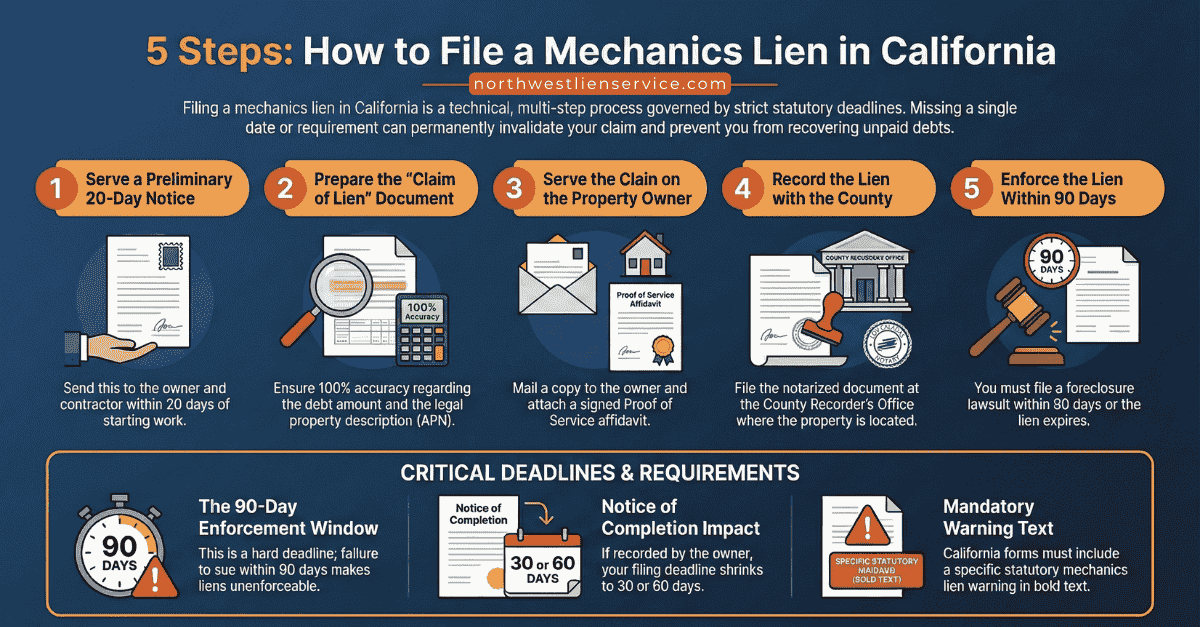
This is the most critical first step for most claimants.
For a clear explanation of how to serve a preliminary 20-day notice in California, check out our How to Send a California Preliminary Notice: Step-by-Step Guide.
If you serve your 20-Day Notice late, it only covers work performed in the 20 days prior. If you start June 1st but send notice July 15th, you have lost your lien rights for all work done in June.
If you’ve completed your work and are still unpaid, you must prepare the “Claim of Lien” document. This is the formal document that gets recorded. It must be 100% accurate and include:
Using a simple street address is often not enough. An incorrect legal description is one of the most common reasons liens are invalidated. We pull title reports to verify the exact legal description and the owner of record as of the filing date, preventing this costly error.
Before you record the lien, California law requires you to serve a copy of the completed Claim of Lien on the property owner.
Take your original, notarized Claim of Lien (with the Proof of Service attached) to the County Recorder’s Office in the county where the property is located.
The Recorder’s office will stamp your document, making it part of the public record. Your lien is now officially “perfected.”
This is the most-missed step and the most costly mistake. Recording the lien does not get you paid. It only secures your right. To collect the money, you must “enforce” (or “foreclose”) on the lien by filing a formal lawsuit.
Enforcement means filing a lawsuit in the proper court to foreclose on the property. This must be done within 90 days of recording the lien. Our service ensures your lien is filed correctly, preserving this right.
How long does a contractor have to file a lien in California? Be sure to track these key dates and time limits to avoid missing any deadlines.
| Action | Deadline | Who It Applies To |
|---|---|---|
| Serve Preliminary Notice | Within 20 days of first furnishing labor/materials | Subcontractors, Suppliers, etc. (Direct contractors only in some cases) |
| Record Claim of Lien (After a “Notice of Completion” is filed) | 30 days for Subcontractors 60 days for Direct Contractors | All parties |
| Record Claim of Lien (If NO Notice of Completion is filed) | 90 days after “completion” of the entire project | All parties |
| Enforce Lien (File Lawsuit) | 90 days from the date you recorded your lien | All parties. This is a hard deadline. |
Swipe left to view full table →
The cost of a mechanics lien is made up of several parts. While fees can change, here’s a rough estimate for what you can expect in California in 2025.
| Cost Component | Estimated Fee (2025) | Notes |
|---|---|---|
| County Recording Fee | $20 – $95 | This is the base fee for the first page, which varies by county. |
| Additional Page Fees | ~$3 per page | A charge for each additional page of the document. |
| Statutory Fees | ~$75 | Many counties add a state‑mandated “Building Homes and Jobs Act” fee. |
| Service Fees | $30 – $150 | Cost to serve notices via Certified Mail or personal delivery. |
| Professional Lien Service | $375+ | Cost for a third‑party service to prepare, verify, and file the lien. |
Swipe left to view full table →
You are not legally required to hire a lawyer to record the initial Claim of Lien. However, the process is highly technical. Any mistake in the California mechanics lien form, deadlines, or service requirements can make your lien invalid. To get paid, you must “enforce” the lien by filing a foreclosure lawsuit —a formal legal action that absolutely requires an attorney. Many contractors opt to use a professional mechanics lien online service, like Northwest Lien, to ensure the initial filing is done correctly and to preserve their rights for a lawyer to enforce later if needed.
Filing a lien yourself saves upfront service fees but exposes you to critical risks, such as invalidation and lawsuits, that a professional service eliminates.
| Feature | Do It Yourself (DIY) | Northwest Lien Service |
|---|---|---|
| Property Owner Verification | ❌ High Risk. You rely on the contract or tax bill, which may not list the legal owner of record. | ✅ FREE Title Search Included. We verify the actual property owner through official county records. |
| Legal Description (APN) | Manual Search. Using just a street address can invalidate your lien. Finding the APN is difficult. | ✅ Verified. We locate the exact legal description required by California law. |
| Forms & Compliance | Outdated? Generic forms found online may miss recent California legislative changes (like the 2011 overhaul). | ✅ Guaranteed. Our forms are reviewed by experts to ensure 100% compliance with current statutes. |
| Filing Process | Time-consuming. Driving to the recorder’s office, standing in line, or mailing and hoping it arrives. | ✅ Fast & Electronic. We use E-Recording in most counties for same-day filing. |
| Liability Risk | ⚠️ High. A clerical error can result in a “Slander of Title” lawsuit against you. | ✅ Protected. We ensure procedural accuracy, protecting you from frivolous counterclaims. |
We’ve helped thousands of contractors and suppliers file mechanics liens in California, Oregon, and Washington since 1999. We specialize in simplifying the process, meeting deadlines, and protecting your right to get paid without the legal guesswork.
“NW Lien has assisted our company with several claims, and they have all ended with us getting paid. Their customer service is great, informative, and they have made the process very easy. [They] always deliver top-notch customer service, they are amazing to work with, and I highly recommend working with them.” – Cassie Endicott, Verified Customer
A Preliminary Notice is a standard informational document sent at the start of a job to preserve your rights. A Notice of Intent to Lien (NOI) is a warning document, often sent before filing a lien, that threatens to file a lien if payment isn’t made. It’s a powerful negotiation tool, but, unlike the Preliminary Notice, it is not a formal legal requirement on most private California projects.
Once you are paid, you are required to file a “Release of Mechanics Lien” form with the same County Recorder’s office. This document clears the lien from the property title. If a lien is invalid, a property owner can also petition the court to have it removed.
Yes, a written contract is not always required to file a mechanics lien in California, especially for subcontractors and suppliers. You only need to prove you provided the labor or materials to the project. However, not having a contract can make it more difficult to prove the amount you are owed.
To challenge a mechanic’s lien in California, first ensure it’s valid by checking for a preliminary notice and the filing date. You can dispute it by filing a lien release bond. If you can’t negotiate a resolution, you might need to sue to remove it or file a petition with the court if the 90-day enforcement period is over.
In California, a mechanic’s lien will be unenforceable if a lawsuit to foreclose is not filed within 90 days of its recording.
Most parties are required to serve a preliminary 20-day notice to preserve their right to file a mechanics lien in California. Failure to provide this notice is generally fatal to lien rights for the work performed.
Generally, the deadline to record a mechanics lien depends on your role in the project (direct contractor vs. subcontractor/supplier) and whether the property owner records a Notice of Completion or Cessation.
| Claimant Type | If NO Notice of Completion Recorded | If a Notice of Completion IS Recorded |
|---|---|---|
| Direct Contractor | 90 days after project completion | 60 days after notice recorded |
| Subcontractor/Supplier | 90 days after project completion | 30 days after notice recorded |
Scroll to read more. →
Filing a mechanics lien in California can be challenging. It’s a complex process with several steps and strict deadlines. While it’s meant to be user-friendly, it can be tough for most people because a simple mistake can cause serious issues. Northwest Lien Service has streamlined filings, helping construction pros avoid rejections and enforce their rights with confidence.
Yes, a lien can be placed on your property without your knowledge, especially if it’s involuntary, such as from unpaid taxes, a court judgment, or a contractor’s claim. While creditors are supposed to notify you, you might remain unaware if notices go to an old address or if legal actions occur without your knowledge. Often, you only find out about the lien when trying to sell or refinance your property.
Senate Bill (SB) 517, from the California Contractors’ State License Board (CSLB), aims to improve transparency in home improvement contracts to prevent unexpected mechanics’ liens.
A mechanic’s lien in California is invalid if it’s filed late, has false information or inflated amounts, is filed by someone unqualified, or if the claimant didn’t give the necessary pre-lien notice. It can also be invalid if the property description is wrong, the correct owner isn’t named, or a sworn statement isn’t filed.
As a property owner in California, you have several methods to address or “get around” a mechanics lien, depending on whether the lien is valid and your goal (immediate removal, contesting the claim, etc.).
You can download the template from the Sacramento County Public Law Library website. Or file with us. We make the process easier for you.
Filing a false mechanics lien in California can lead to serious consequences. It’s a felony under Penal Code § 115, with penalties of up to three years in prison and a fine of up to $10,000. Plus, the property owner can sue for damages, including attorney’s fees.
Criminal penalties
Civil penalties
No. Under Business & Professions Code § 7031, unlicensed contractors are barred from bringing any action for compensation. Unlicensed contractors (for licensed work) are prohibited from claiming payment, including through liens, and may be required to return any funds already received.
What this means in practice
No. Unlike Florida or Michigan, California does not use a “Notice of Commencement.” You do not need to look for one or file one to start a project.
Key documents to watch for instead
Bottom line: Focus on sending your Preliminary Notice on time rather than looking for a Notice of Commencement.
Generally, no. California lien deadlines are strict. If you fail to record your claim within 90 days of the project’s completion (or sooner if a Notice of Completion was filed), your lien will likely be invalid and unenforceable.
The consequences of filing late
Note: The 90-day clock usually starts from the completion of the entire project, not just your specific work. However, if a Notice of Completion is filed, your deadline shrinks to just 30 days (for subcontractors) or 60 days (for direct contractors).
No. In California, you cannot hold a lien against your own property because a lien represents a debt owed to another party. Under the legal Doctrine of Merger (codified in Civil Code §§ 805 & 811), any lien you attempt to hold against yourself would automatically extinguish because you already own the property.
Refers to the body of statutes found in the California Civil Code (Sections 8000–9566) that govern mechanics liens. These laws establish the rights of contractors, subcontractors, and suppliers to secure payment for work performed on a property. The law dictates strict deadlines for sending notices, recording liens, and enforcing claims.
A legal document exchanged at the time of payment. By signing a waiver, a contractor gives up their right to file a lien for the specific amount they have been paid. California has four statutory waiver forms: Conditional and Unconditional (for Progress Payments) and Conditional and Unconditional (for Final Payments). Using the wrong form can accidentally waive your rights before you actually get the money.
A document filed with the County Recorder to remove a mechanics lien from a property’s title. This is required once a lien claim has been fully paid or satisfied. Failing to file a release after being paid can lead to legal penalties.
Need to remove a lien? File your Lien Release with us today →
These are the specific legal templates required by the California Civil Code to preserve and enforce lien rights. Key statutory forms include the Preliminary Notice, the Claim of Mechanics Lien, and the four Waiver and Release forms. California law mandates that these documents contain precise statutory language, such as the “Notice of Mechanics Lien” warning in bold type, to be valid. While a Notice of Intent to Lien is often used as a courtesy to prompt payment, it is generally not a legal requirement for most contractors in California. If any form is missing required text, is formatted incorrectly, or fails to meet strict service requirements, a County Recorder may reject the filing, or a court may declare the lien unenforceable. Register for FREE to file your liens →
Commonly known as the Preliminary 20-Day Notice, this document is a mandatory prerequisite for most subcontractors and suppliers to preserve their right to later file a mechanics lien, stop payment notice, or bond claim. Under California Civil Code Section 8200, the notice should ideally be served to the property owner, direct (general) contractor, and construction lender within 20 days of first furnishing labor or materials.
Don’t risk your rights. Register for FREE to start filing your Preliminary Notice →
Disclaimer: This article is for informational purposes only and does not constitute legal advice. Mechanics lien laws are complex and vary by jurisdiction. For specific legal guidance regarding your situation, please consult a qualified California-licensed attorney.